A module that goes alongside my keycaps and taxonomy, I am tasked with designing “something between a smartphone and a dumbphone”.
The brief
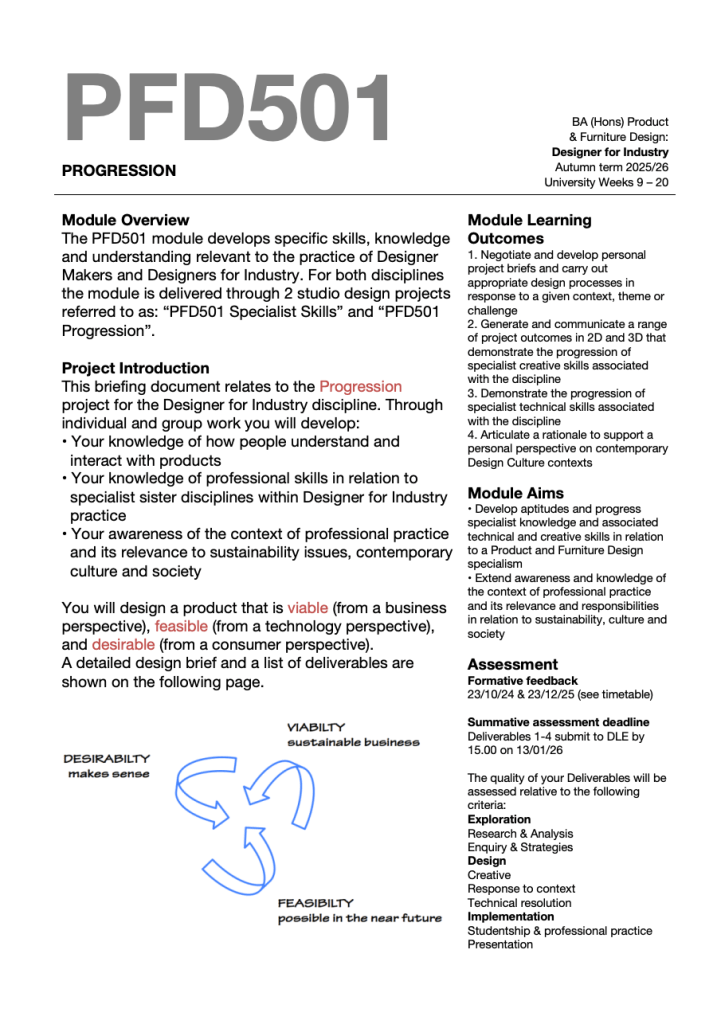
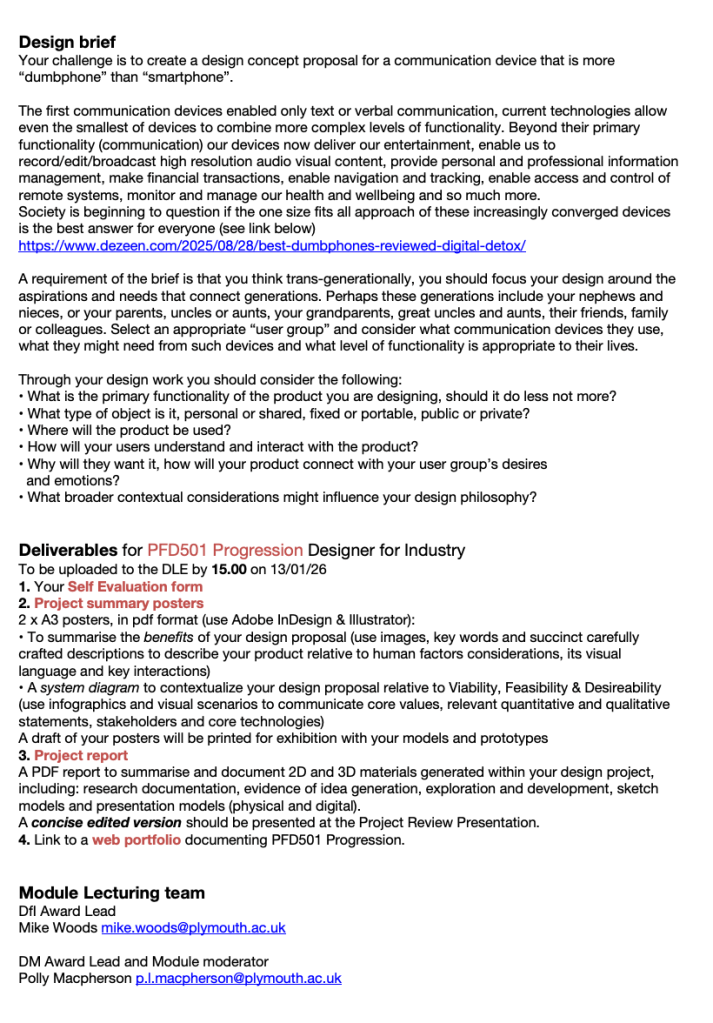
The lecture in which we learnt of our task was heavily focussed on research, and identifying user groups. This seems like a chore, but that may only be because i’m not yet used to research, and if I am to be a good product designer then I must be able to identify user groups.
First Steps
My first action was to make a plan by adding weekly objectives to my personalised brief. I had already left space for the progression task, so very little editing was necessary.
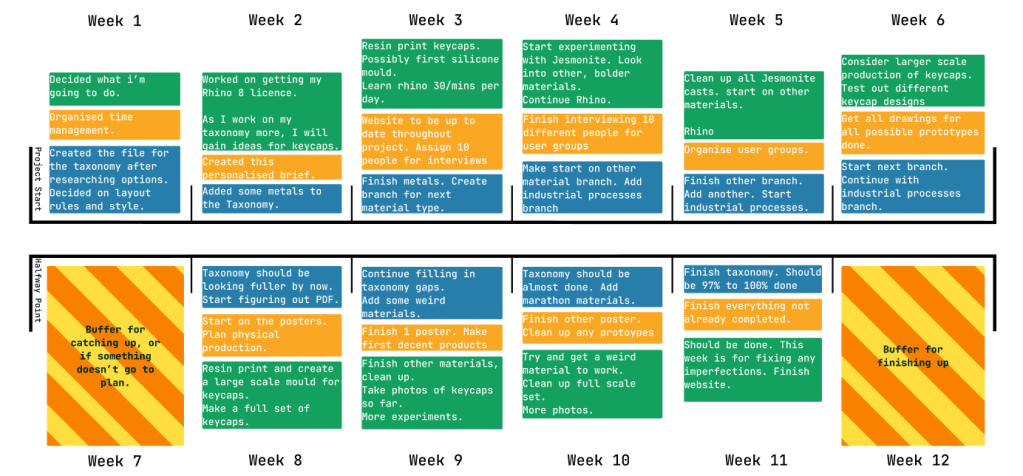
My goal for week 3 (the week I start this project) is to update this website, and assign 10 people to interview. This will hopefully give me at least a shallow understanding of the user groups I am to design for. Since the brief states trans-generational design, I will try to have a broad range of people from all age groups.
Interviews
For the interviews I will try to speak to:
- 3x children under 15
- 3x young adults 15-25
- 2x adults 26-55
- 2x older adults 55
This is to try and target people from different generations, and in different life stages.
I predict that most children will have high screen times, yet be unwilling to switch to a dumb device.
Young adults will have high screen time, and be willing to switch to a dumb device, at least for short periods of time.
Adults will have much lower screen time than the 2 younger generations, but will still be willing to try a dumb device to lower their screen time further.
Older adults will have the lowest screen time, and would not be willing to switch to a dumb device, but for different reasons than other hesitant groups.
Interview Script
The questions i’m asking the interviewees are vital, so I want to work on a script before any interviews take place to ensure things run smoothly.
The key focuses of the project are based around creating a dumb device that connects generations.
The interview questions will be loosely guided by the following structure. This is not essential reading, as the interviews will be posted further down the page.
To start with I’ll ask some basic introductory questions, such as:
- Name
- Pronouns
- Age
- Job / occupation
- Screen time; does your screen time vary much?
Then we can get into more topic-related questions, that give key insights to create a better product. For some screen time related questions:
- What would you say are the top 3 things you spend your time on your phone doing?
- How long do you think you could go without your phone; how long have you gone?
Then we can gear more towards the product:
- What do you think are the 3 most important things a phone must be able to do.
- What are your top 3 things that you want your phone to be able to do?
- Are there any features of a phone you don’t think you could live without?
- What things are holding you back from permanently ditching your phone?
- Do you use any other technology in your life that fills in any of these blanks?
- Do you think your phone is an overall improvement or detriment to your life; why?
- What phone do you have and how much did it cost?
- Do you use screen time limiters on your phone?
- How often do you go on/check your phone mid conversation? Do you have any friends who do?
Then we move onto more cultural questions:
- At what age do you think children should first be allowed to have access to a smart phone?
- At what age did you have your first phone?
- Are there any people you want to be able to always contact at a moments notice, or is there anyone who wants to be able to always contact you?
Then we move back onto more specific product orientated questions:
- The product I have in mind is a set of jewellery that can fill a specific function of a phone, while not having any other functions. IE a ring that acts as a mobile phone, allowing someone to ring you without requiring your phone, or a bracelet that stores music, and connects to wireless ear/headphones. You stated that [x], [y], and [z] are the things you couldn’t live without, would you be potentially interested in these functions but in a different form?
- How much would you be willing to pay for one of these products?
- Do you think you would use these products instead of your phone, in tangent with your phone, or in exceptional cases where you don’t have your phone.
- Would you prefer for the jewellery to have no interface, or a small interface for interacting with.
- Do you want to be able to use these features, or is it more about being available to certain people.
Meet the Interviewees (I could get a hold of)
Dr. Tim Minu-Browne
32
Software Developer
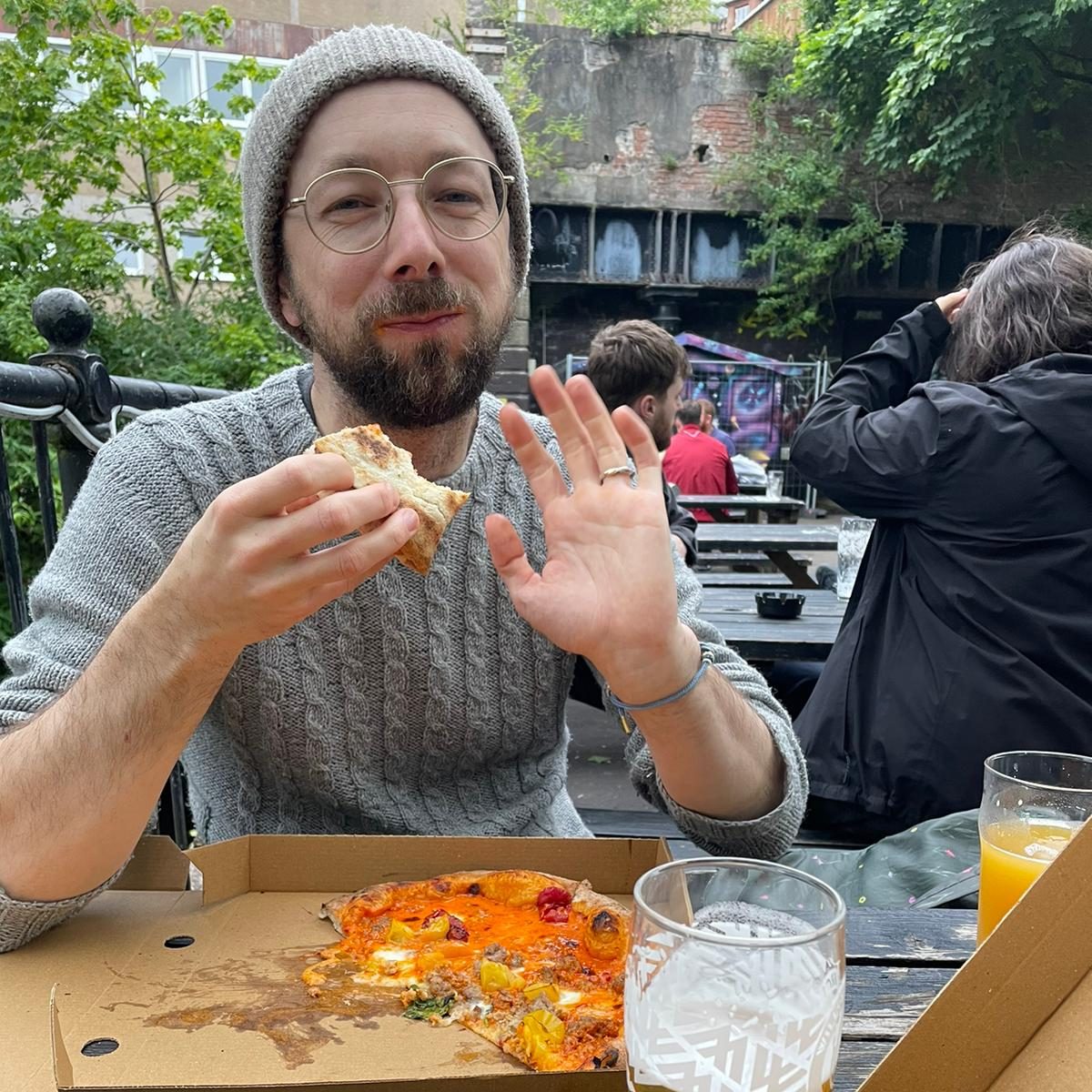
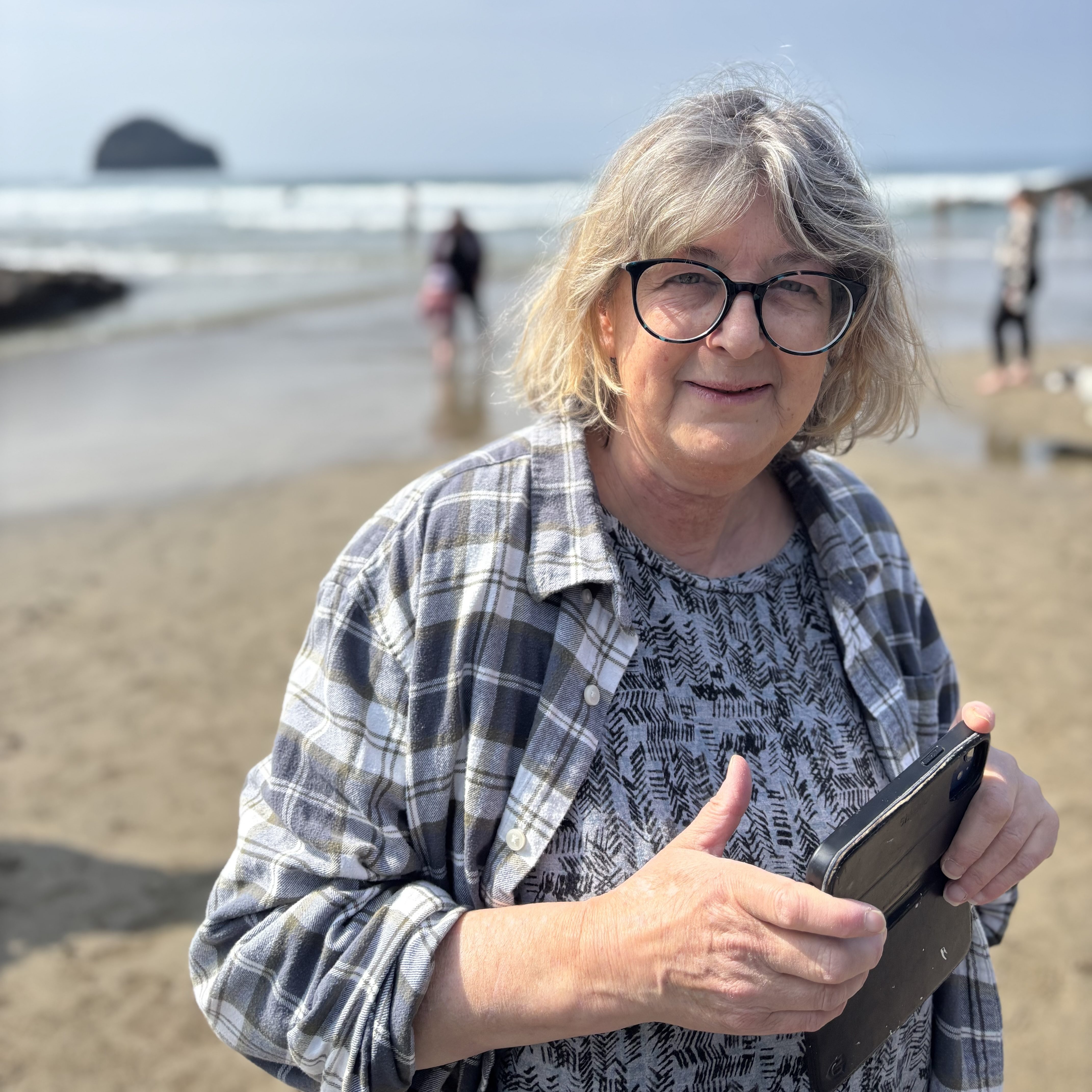
Daphne Murray
58
Artist and Writer
Dom Aversano
40
Composer
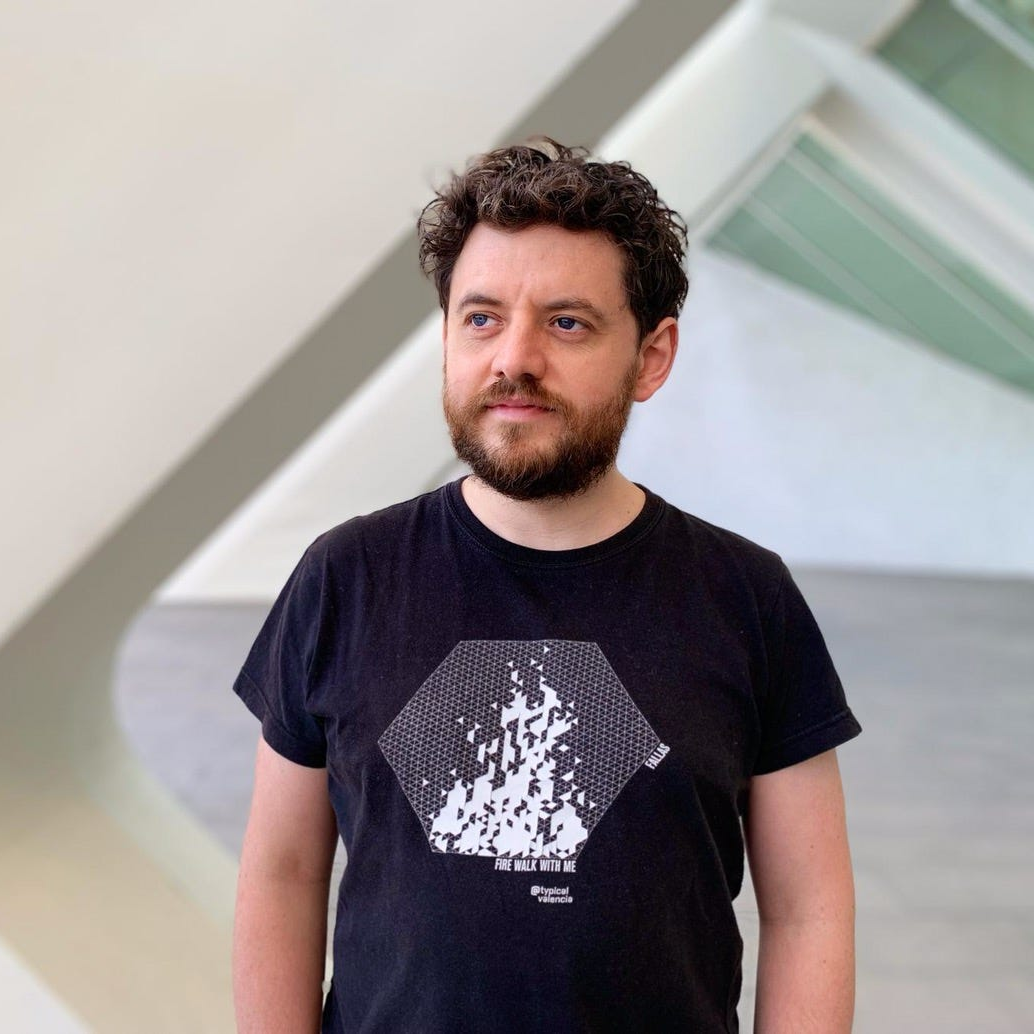
As you can see I wasn’t able to get a hold of nearly as many people as I originally wanted. The interviewees, however, were invaluable. The age range wasn’t what I wanted because unsurprisingly I don’t have many contacts for very young or very old people, and the range of occupations is limited to the arts. Not ideal but with this working in tangent to outside research, I should be able to have a pretty good idea for what to the market, and consumers, want.
Not everyone is available all the time. In my spare time I can get some initial sketches down for the product.
I have in mind wearable technology, that can fill in a specific function of a phone, to make it easier for people to part with theirs. I believe the market for this would be expansive, especially as time goes on, and screen time continues to rise throughout generations. I will, however, gather more knowledge about the possible markets for this product as I interview people.
Notes on interviews
I’ve learnt a lot through this interview process, possibly the most important of which is that i’m no longer just doing things for a school project, or to put it another way: the stakes are higher. I need to be serious and upfront about things like privacy, and making it clear to people what i’m using their image, voice, words, etc for.
Another thing i’ve found is that it is very difficult to get hold of people outside of my age group, especially those younger than me.
The only gen-alpha person I know is my niece, and she is often busy with school and homelife, so organising even a half an hour call with her proved too difficult.
Thorough online research showed surprisingly few studies about screentime, and phone related anxiety. A few of the big ones were one conducted by the UK post office, and another studying teens in India.
The post office study in particular was the first to coin the term “Nomophobia”, the fear or anxiety caused by not having ones smart phone either on hand, or functioning.
I put together all of my studies on the topic, including the identification of user groups helped by my interviews, onto a presentation.
The next step was to actually design the products.
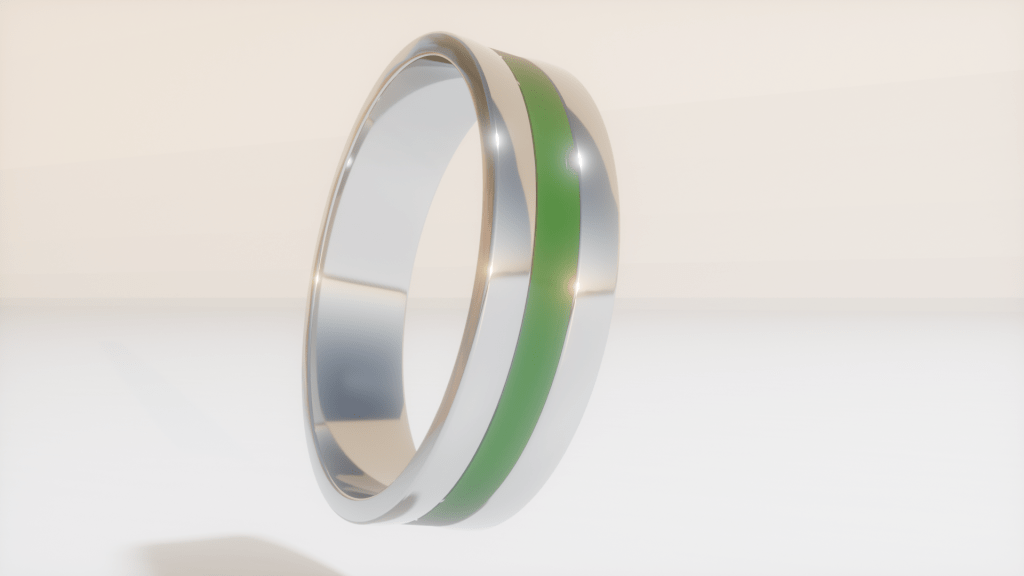
For the communication ring, I wanted a subtle LED band going through the middle of it that could glow when receiving or sending a call. I based the dimensions off of a ring that I wear everyday.
To account for the desire for information on hand, I designed a concept that I imagine most tech startup companies are working on at the moment: an AI on a wristband.
The idea was that it would be audio communication from the user, while the wristband would be able to access the internet on the users behalf, show map directions on a small 16 x 16 display (something minimal such as an arrow and a number), talk to the user to answer any questions or queries they may have, and possibly link to other smart jewellery and function as the “brains” of the operation.
I had a neat idea of someone in a scenario where they have left their phone behind, but had to access a QR code such as a restaurant menu. They could use a camera pendant to scan the QR code, then discuss their order with the Large Language Model in their wristband.
This idea is not yet feasible, but with the huge investments being put into AI at the moment, the technology will surely be with us very soon.
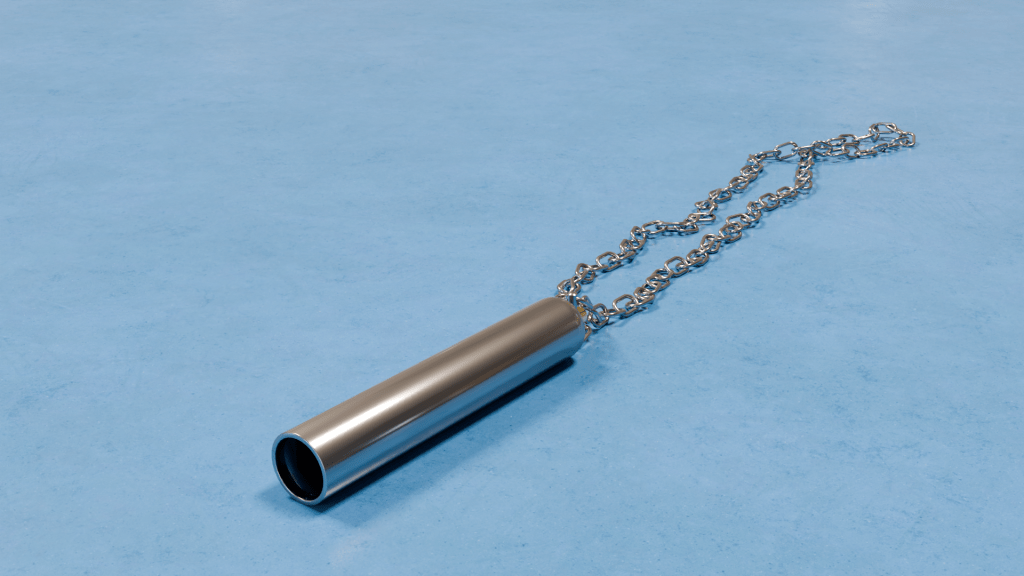
The camera pendant I spoke of was the third and final product I designed. A camera necklace that could rival smartphone cameras, and allow people who consider their constant access to a camera essential.
The device would have no visual interface, being operated by a button that connects to the chain. The device would send photos via bluetooth directly to someones smart phone once in range.
The next task was to create posters for the project, one of a system map explaining the product, and another showing off the product in it’s best light. For this I had to make renders. I used blender since it’s UI for rendering and adding materials in unmatched by any other software I have available to me. Rhino is capable of rendering materials and lighting, but it is borderline unusable compared to Blender.
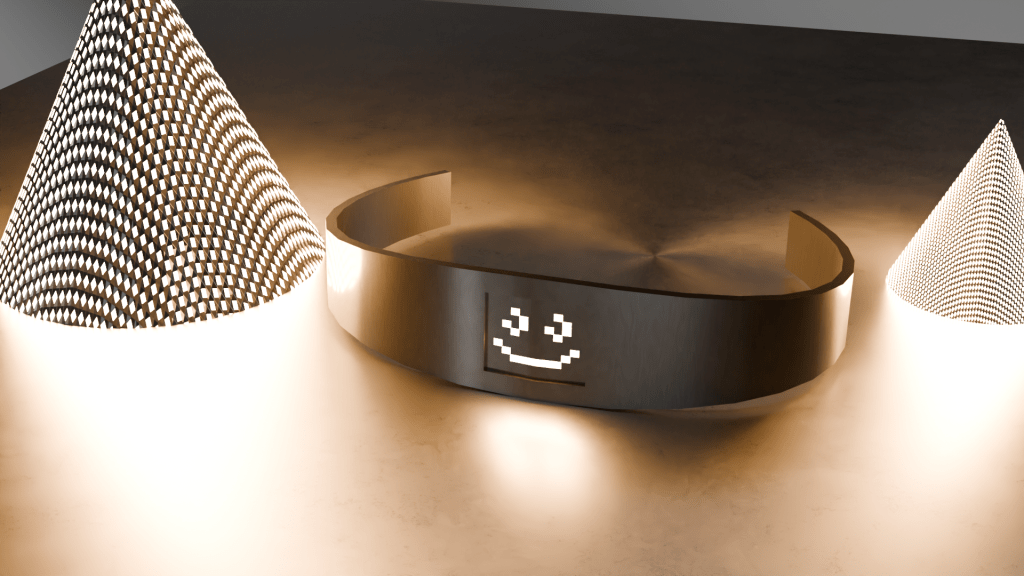

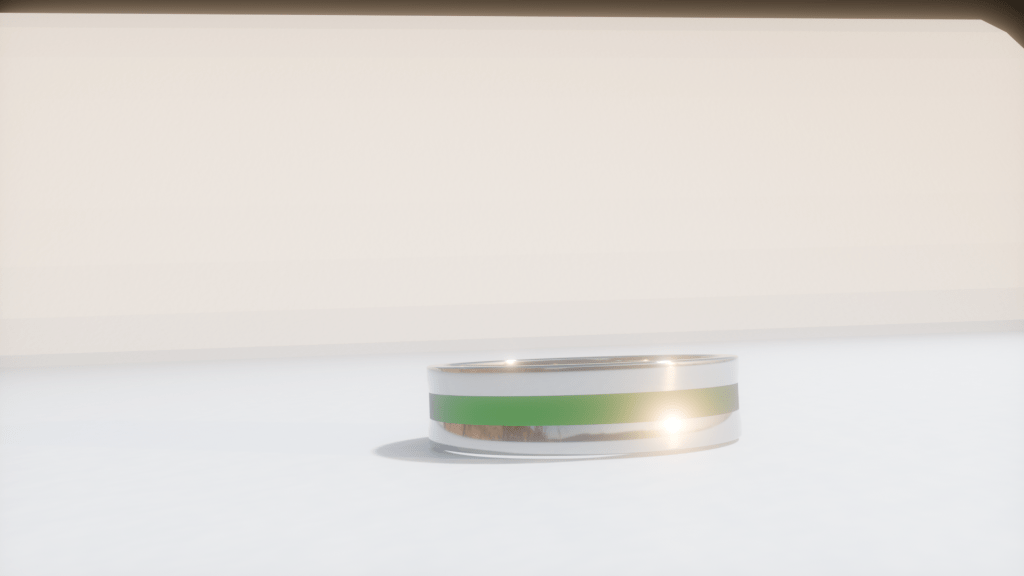
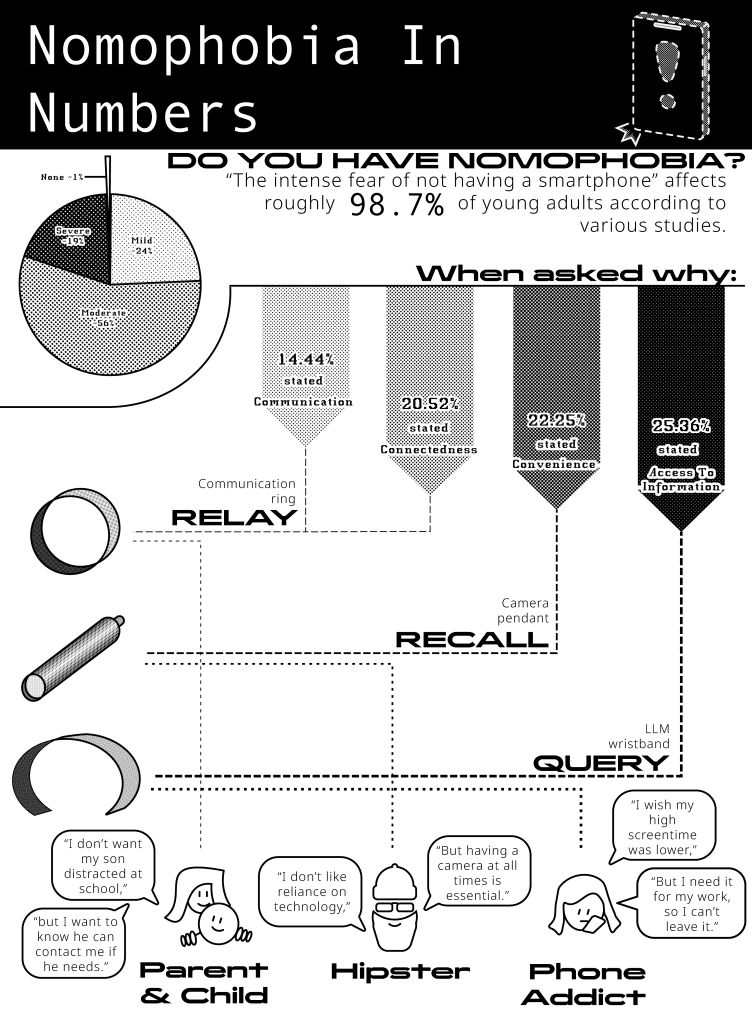
I’ve not much experience with Adobe Illustrator, so this poster was very educational. I struggled on how to make a system map for something like this, but I went with mapping out who each product is designed for.
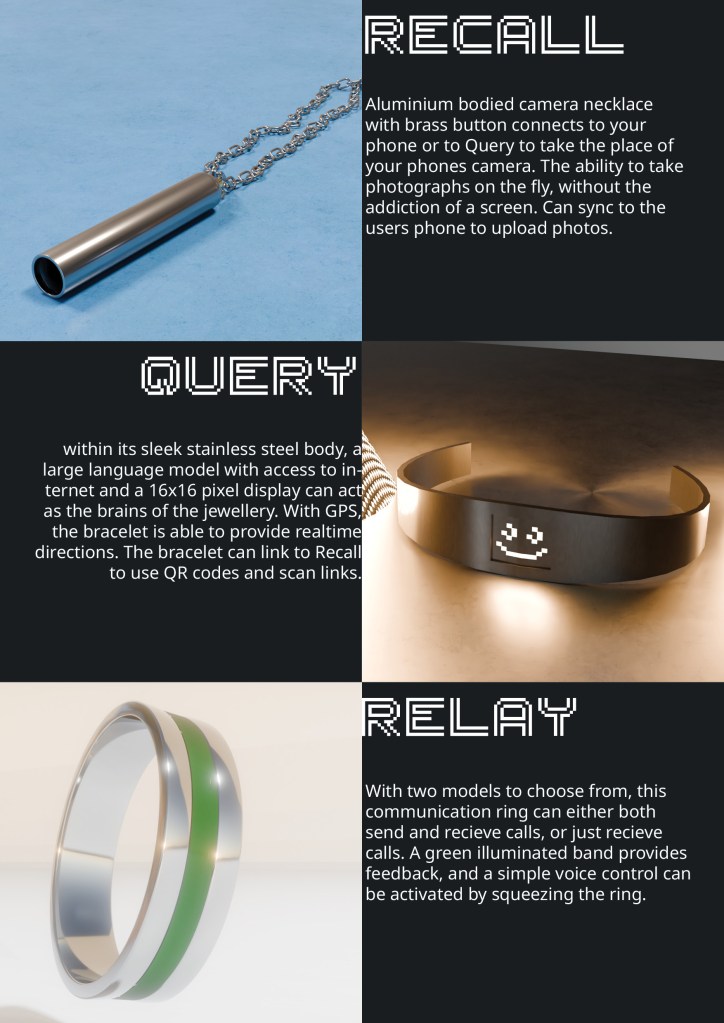
This poster was more rushed than the other, but I actually thinks it has just the impact it requires. I gave each of the pieces of jewellery fitting names, as well as a description of what it is and does.
The next and final step was to create final sketch models (FSMs) of each product. By this time the university workshops had closed for Christmas, so I had to order the 3D prints from a 3rd party. The quality came out surprisingly well, having used a 0.2mm nozzle on an FDM printer. I then used silver spray paint and added a few final details and the FSMs were done!
Overall I’ve enjoyed this project. It was nerve-wracking to interview people, especially Dom Aversanto, who I did not know prior to this project.
Overall i’m happy with how this project turned out, although I do feel like I could have stuck closer to the brief. I fear I tunnelled onto the dumbphone aspect, while sidelining the trans-generational requirement of the brief. I partially combated this by including a mother and her child as part of the target audience, as well as interviewing a range of generations.
 Raphael Murray Browne